
On 5 November we released one of the biggest changes to Smartle in a long time. And it is not something you can see on the screen. We replaced the dictionary - the list of words the game accepts and the definitions you read. It started on smartle.net, and today the update reached the Smartle mobile apps too.
I knew that some players would notice. I did not know how fast. The same day one of our most dedicated players asked on Discord what happened to the dictionary. They have played Smartle almost every day since February 2023 and keep their own list of every word they found in the game. Some words that worked for them for years were suddenly not accepted anymore. Honestly, this level of dedication amazes me. And it also made me realise that I owe everyone an explanation of what we changed and why.
Why we touched the dictionary at all
I love Smartle as it is. But our data shows that Smartle is a very hard game to start with for beginners and casual players who just want fun daily word games. We want to make Smartle easier to get into, and I decided to begin with a good foundation. And the foundation of every word puzzle is its dictionary.
The old dictionary had three big problems:
- Definitions. Many of them were too long, too specific and some were complete nonsense.
- Missing words. Just a few days before the update somebody emailed us asking why PLOWS is not accepted. Good question.
- Very rare words. Smartle is a word building puzzle, and when a board needs a word almost nobody knows, players start swapping letters randomly or use a hint. And building a word by luck does not feel like a win.
What changed
We went through 27,792 English five-letter words with a set of rules, and 14,238 of them are accepted in Smartle now. The rules are easy to say and much harder to apply:
- A word needs an ordinary meaning. Being a name, a brand or an abbreviation is not enough.
- Places, peoples and languages stay only when most people know them. PARIS and HINDI are in, small towns and rivers are out.
- Foreign words and rare or nonstandard spellings are out (MERCI, THICC).
- Contractions most people know are in (KINDA).
- Words whose main meaning is vulgar, and slurs, are out.
- Everything else stays. Obscure real words are still in the game.
There are some nice surprises too. Players from the UK will be happy to know that ODOUR and BAULK are accepted now. Before, only the US spellings worked.
We also rewrote every definition. They are short now and the meaning most people know comes first. And when you ask for a hint, Smartle prefers well-known words, so a hint actually helps instead of showing you a word you have never seen before.
What we lost
I don’t want to pretend this change has no price. The same player who noticed the update first shared a list of beautiful words they discovered in Smartle over the years: ANNWN, SGURR, WEIQI, KUNQU, AEAEA. Each of them led to a map, a river, a mountain or a piece of culture. Most of those words are not accepted anymore.
They also made a point I keep thinking about. Words that belong to one country or culture - a town, a river, a local dish - can make a player from that place smile, and teach everyone else something new. With the new rules most of these “national” words are gone.
This is a real trade-off. Some players love Smartle as a rare word game, others feel frustrated when the puzzle needs a rare word. I hear both sides, and I don’t have a good way to measure where the majority is. So for now we keep the dictionary as it is. We plan to change it again only if we find major problems, or if we agree together as a community to bring rare or regional words back.
German and Spanish
Together with the new English dictionary, two new languages came to Smartle: German and Spanish. We wrote the rules so they work in any language, so both dictionaries are built the same way as the English one. And just like in English, every word you find comes with its definition - in German or in Spanish. You can find them on smartle.net/de and smartle.net/es, or choose the language in the game menu.
A 5-letter word finder
Together with the new dictionary we released a new free tool: the 5-letter word finder. Funnily enough, a player asked us for exactly this back in September - a way to “interrogate” the Smartle dictionary.
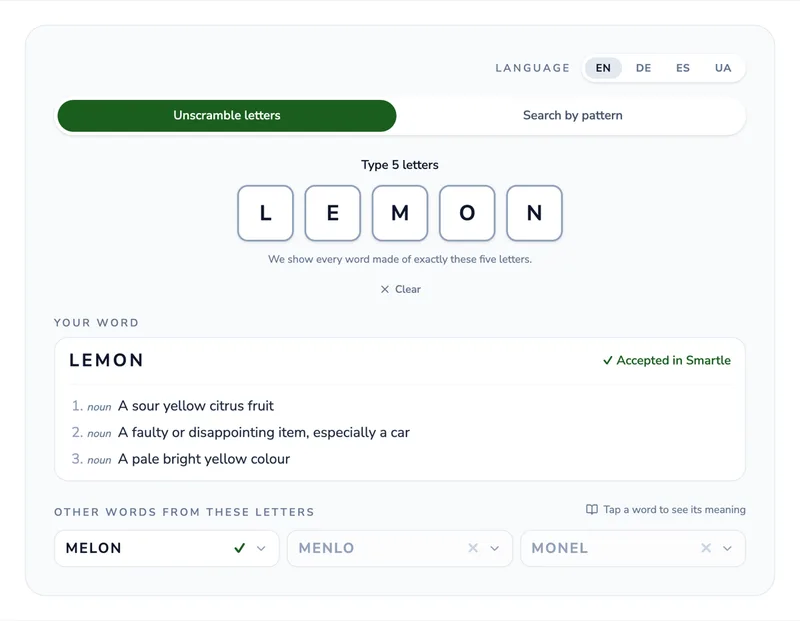
It has two modes:
- Unscramble letters: type five letters to unscramble them into every word made of exactly these letters.
- Search by pattern: put the letters you know in their places, and add letters the word has somewhere or does not have at all.
Every word shows whether Smartle accepts it, and you can tap a word to read its meaning. The best-known words come first, and you can use it as often as you like. The word finder works in all four languages: English, German, Spanish and Ukrainian.
Can you use it to cheat in the word puzzle of the day? It can help you solve the puzzle, but it will not give you the full solution straight away. We made it so you can check a word against the Smartle dictionary without having to build it in the game first.
Tell us what you think
A lot of what I wrote here started as a conversation with players, and that conversation is still going. You can read the whole discussion in the #smartle-general channel on our Discord server and join in.
I would really like to hear from you. Do you enjoy finding rare words and place names in your daily word challenge, or do they frustrate you? Should regional words come back? This is a decision we want to make together.